Hello guys, welcome back to our blog. In this article, I will discuss the OBD-ll to UDS migration benefits and the compatibility issues.
Ask questions if you have any electrical, electronics, or computer science doubts. You can also catch me on Instagram – CS Electrical & Electronics
- CAN vs CAN-FD vs Ethernet: Choosing the Right Automotive Network
- Neuromorphic Computing In The Automotive: Driving The Future With Brain-Inspired Intelligence
- Why Automakers Are Building Their Own Vehicle Operating Systems
OBD-II to UDS Migration
The automotive industry has undergone a significant transformation in recent decades, driven by advancements in electronics, software, and communication protocols. Among these, On-Board Diagnostics (OBD-II) has played a crucial role in vehicle diagnostics, emissions monitoring, and repair. However, with the increasing complexity of modern vehicles and the need for more flexible, scalable, and secure diagnostics, the industry is steadily moving towards the Unified Diagnostic Services (UDS) protocol.
This article provides an in-depth analysis of the migration from OBD-II to UDS, exploring the benefits, compatibility issues, and strategies for a seamless transition.
01. Understanding OBD-II and Its Role in Automotive Diagnostics

1.1 What is OBD-II?
OBD-II (On-Board Diagnostics II) is a standardized system implemented in vehicles primarily for emissions control and diagnostic purposes. Mandated in the US since 1996 and later adopted globally, OBD-II provides access to the status of various vehicle subsystems via a standard connector (SAE J1962) and communication protocols like:
- SAE J1850 PWM/VPW (older vehicles)
- ISO 9141-2
- ISO 14230 (KWP2000)
- ISO 15765-4 (CAN)
1.2 Key Features of OBD-II
- Emission Monitoring: Real-time monitoring of emissions-related systems.
- Diagnostic Trouble Codes (DTCs): Storage and retrieval of standardized fault codes.
- Mode-Based Services: Uses ten modes (Mode $01 to Mode $0A) to access vehicle data (e.g., PID requests, freeze frames, readiness monitors).
- Generic and Manufacturer-Specific Support: Combines common diagnostics and OEM extensions.
1.3 Limitations of OBD-II
- Limited flexibility for OEM-specific services.
- Inadequate for high-speed, high-data systems (e.g., ADAS, EV battery systems).
- Poor scalability for complex ECUs.
- No built-in security measures.
Introduction to UDS (Unified Diagnostic Services)
2.1 What is UDS?
UDS, defined in ISO 14229, is a service-based diagnostic protocol that provides a robust and scalable architecture for automotive diagnostics over different transport layers like CAN (ISO 15765-2), K-Line (ISO 14230-3), or Ethernet (DoIP – ISO 13400).
2.2 Structure of UDS
UDS services are organized into Service Identifiers (SIDs), categorized into:
- Diagnostic Session Control (0x10)
- ECU Reset (0x11)
- Security Access (0x27)
- Read/Write Data by Identifier (0x22/0x2E)
- Routine Control (0x31)
- Communication Control (0x28)
- Clear DTCs (0x14)
2.3 Key Features of UDS
- Full vehicle coverage (emission, powertrain, body, infotainment, chassis, etc.)
- OEM-definable services and sub-functions
- Multiple session types (default, programming, extended diagnostics)
- Enhanced security mechanisms
- Scalable for over-the-air updates and DoIP
03. Why Migrate from OBD-II to UDS?
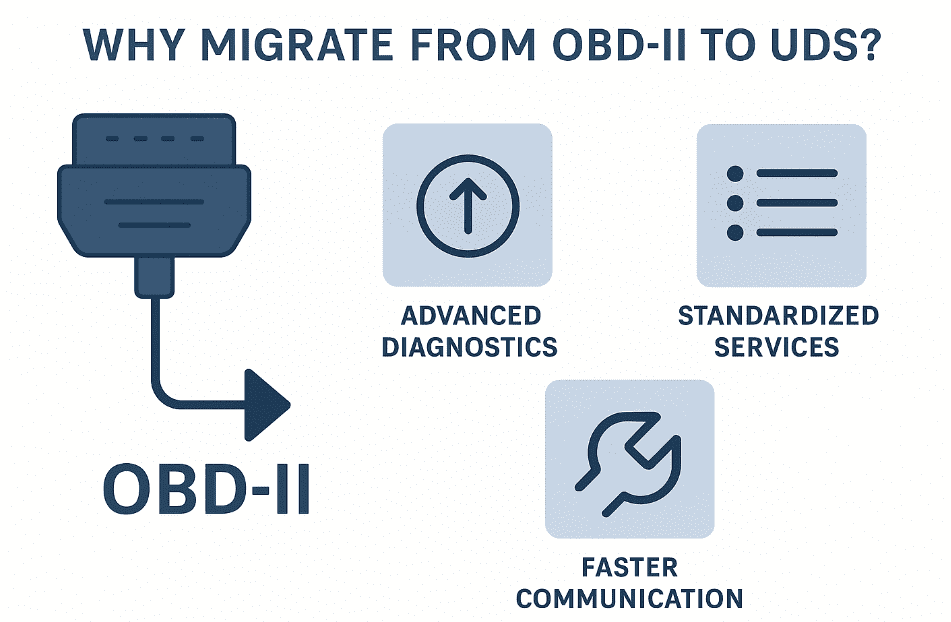
3.1 Enhanced Diagnostic Coverage
UDS enables diagnostics beyond emission systems, covering the entire vehicle. This is essential for modern architectures with 80–100 ECUs.
3.2 Scalability for EVs and ADAS
OBD-II was never designed for electric vehicles or autonomous systems. UDS offers the scalability to diagnose complex systems like:
- Battery Management Systems (BMS)
- Lidar/Radar ECUs
- Central domain controllers
3.3 Programming and Flashing Support
UDS supports software flashing and reprogramming via services like 0x34 (Request Download) and 0x36 (Transfer Data), which is absent in OBD-II.
3.4 Security Features
With Security Access (0x27) and encryption options, UDS supports access control and protection against unauthorized diagnostic attempts.
3.5 Support for DoIP (Diagnostics over IP)
UDS works over Ethernet-based diagnostics, enabling faster communication, especially for OTA (Over-The-Air) updates.
04. Compatibility Challenges in OBD-II to UDS Migration
4.1 Protocol Layer Incompatibility
OBD-II mainly uses CAN (ISO 15765-4) or legacy protocols like ISO 9141, while UDS is designed for ISO 14229 with CAN, K-Line, or Ethernet (DoIP). This mismatch can lead to transport layer incompatibility.
4.2 Tooling and Equipment Transition
Existing scan tools and test benches for OBD-II may not support UDS or require firmware updates. OEMs and suppliers must invest in new UDS-compatible tools such as:
- Vector CANoe with UDS protocol stack
- dSPACE AutomationDesk
- ETAS INCA with UDS plugins
4.3 ECU Reprogramming
Many legacy ECUs were not designed with UDS stacks. Migration often requires redesigning or re-flashing ECUs to include UDS software.
4.4 Compliance with Regional Regulations
Regions like the U.S. (EPA/SAE), Europe (EOBD), and China have regulatory mandates specific to OBD-II. UDS migration must retain backward compatibility for regulatory compliance.
4.5 Vehicle Architecture Limitations
Some older vehicles lack sufficient memory or processor capabilities to support UDS services, especially those related to programming or cryptographic security.
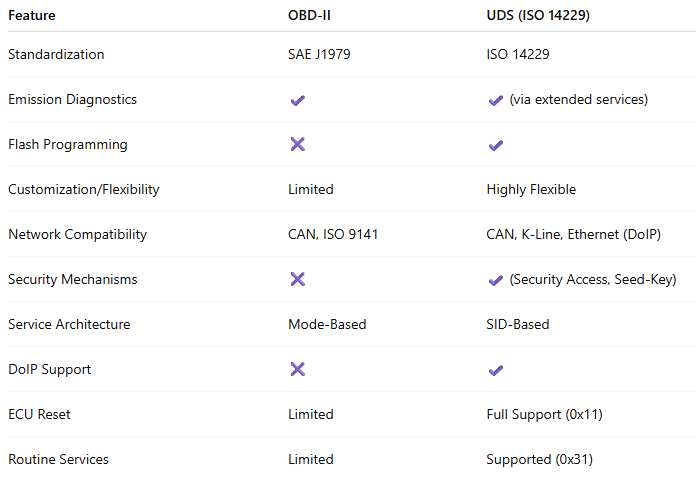
05. UDS vs OBD-II: Feature Comparison Table
06. Migration Strategy: Steps to Transition from OBD-II to UDS
6.1 Assessment Phase
- Identify ECUs currently using OBD-II
- Evaluate hardware capabilities (e.g., memory, CPU, transport layer support)
- Assess compatibility with UDS stack requirements
6.2 Architecture Planning
- Define diagnostic architecture using UDS over CAN or UDS over DoIP
- Implement diagnostic layers compliant with ISO 14229 and ISO 15765 (for CAN)
6.3 Stack Integration
- Integrate UDS software stack (can be purchased or custom-developed)
- Include security services, session handling, and diagnostic states
- Example vendors: Vector, ETAS, KPIT, Bosch
6.4 Diagnostic Services Development
- Implement required SIDs (0x10, 0x11, 0x22, 0x27, etc.)
- Define DID (Data Identifier) map, routines, and configuration parameters
6.5 Toolchain Upgrade
- Update vehicle interface tools (VCI), diagnostic software, and backend systems
- Ensure test benches and HIL setups support UDS
6.6 Testing and Validation
- Use Test Automation (e.g., CANoe, VT System) for service validation
- Perform negative and positive test cases for each SID
- Validate timing constraints and memory usage
6.7 Compliance and Certification
- Validate against ISO 14229 and regulatory standards
- Ensure backward compatibility with OBD-II where required (e.g., emissions reporting)
07. Case Study: OEM Migration to UDS
An OEM had an OBD-II implementation across all ECUs for basic diagnostics. With the introduction of electric vehicles, they needed.
- Secure diagnostics
- High-speed data transfer
- OTA updates support
Migration Steps:
- Retrofitted UDS stacks on new generation ECUs
- Used DoIP for battery ECU and infotainment
- Maintained backward OBD-II support for emission ECUs
- Used secure access for critical functions (calibration, reprogramming)
- Deployed diagnostic sessions: Default (0x01), Extended (0x02), Programming (0x03)
Result:
- Reduced diagnostic time by 40%
- Improved security against reverse engineering
- Enabled remote diagnostics and update capabilities
08. Future of Automotive Diagnostics

The future is shaped by connected, autonomous, electric, and software-defined vehicles. In this context, UDS provides a strong foundation, but emerging trends are also influencing diagnostic approaches:
8.1 Cloud-Based Diagnostics
- Vehicle-to-cloud communication enables remote UDS sessions
- Predictive maintenance using UDS logs and AI analytics
8.2 Cybersecurity Enhancements
- Integration with automotive cybersecurity standards (ISO/SAE 21434)
- Use of encrypted UDS commands and certificates
8.3 Unified Diagnostics and Flashing (UDaF)
- UDS extension for standardizing flashing across multiple ECUs and OEMs
- Focused on tool-agnostic, scalable firmware updates
Conclusion
Migrating from OBD-II to UDS is not just a technological upgrade—it’s a necessity in the era of complex, software-centric vehicles. While the transition poses compatibility, tooling, and cost challenges, the benefits in scalability, security, performance, and coverage make UDS the preferred choice for the future.
OEMs, Tier-1 suppliers, and diagnostics tool developers must collaborate to ensure that migration strategies are well-planned, validated, and compliant. As we step into the realm of autonomous, electrified, and connected vehicles, UDS emerges as the backbone for intelligent diagnostics, in-vehicle software management, and secure serviceability.
#AutomotiveDiagnostics #OBDII #UDSProtocol #VehicleDiagnostics #AutomotiveEngineering #ISO14229 #UDSMigration #CANBus #DoIP #EVDiagnostics #ECUProgramming #SoftwareDefinedVehicle #AUTOSAR #AutomotiveCybersecurity #DiagnosticServices #VehicleMaintenance #SmartVehicles #ConnectedCars #ADAS #AutomotiveSoftware #AutomotiveTrends #VectorTools #dSPACE #ETAS #ISO15765 #CANFD
Thank you for reading “OBD-II to UDS Migration: Benefits And Compatibility Issues“. Also, read:
- “Mother of All Deals”: How The EU–India Free Trade Agreement Can Reshape India’s Economic Future
- 10 Free ADAS Projects With Source Code And Documentation – Learn & Build Today
- 100 (AI) Artificial Intelligence Applications In The Automotive Industry
- 1000+ Automotive Interview Questions With Answers
- 2024 Is About To End, Let’s Recall Electric Vehicles Launched In 2024
- 2026 Hackathons That Can Change Your Tech Career Forever
- 50 Advanced Level Interview Questions On CAPL Scripting
- 7 Ways EV Batteries Stay Safe From Thermal Runaway