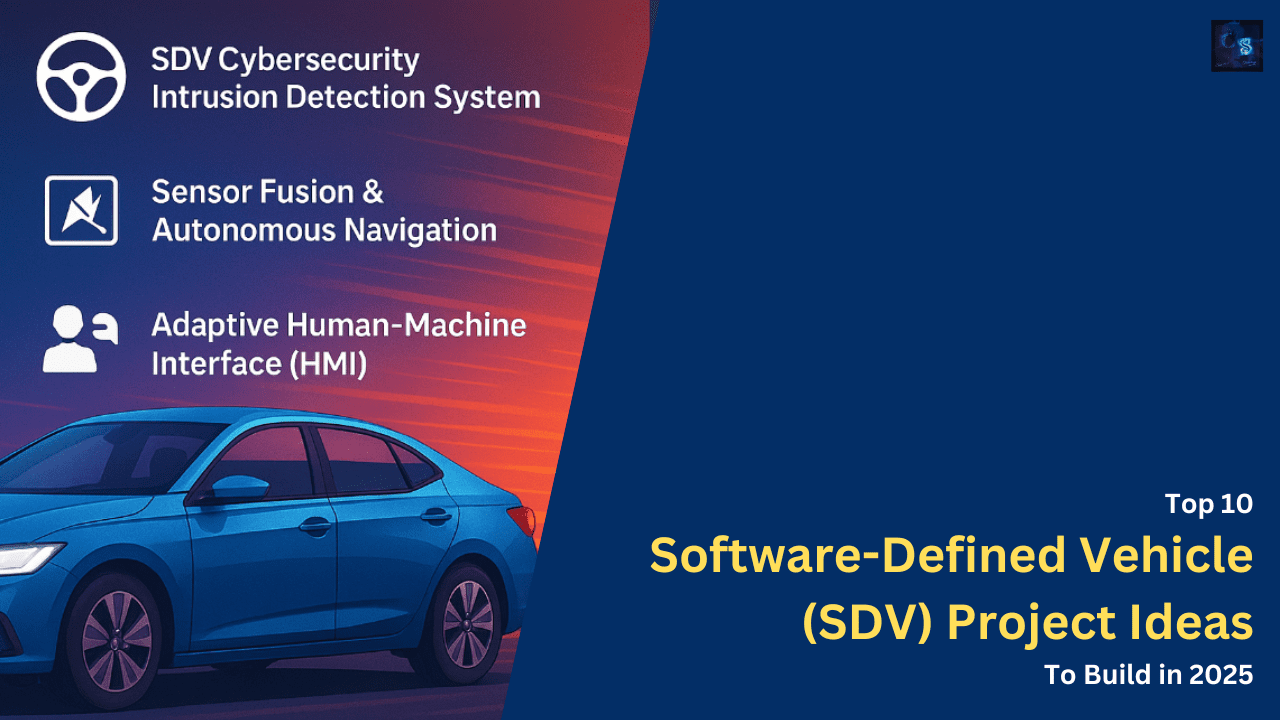
Hello guys, welcome back to my blog. In this article, I will discuss the top 10 software-defined vehicle (SDV) project ideas to build in 2025, and it’s key features.
Ask questions if you have any electrical, electronics, or computer science doubts. You can also catch me on Instagram – CS Electrical & Electronics
- Top 10 Software-Defined Vehicle (SDV) Projects You Should Know About
- The Future Of Battery Management Systems In The Era Of Software Defined Vehicles
- Automotive-Grade Microcontrollers Vs General-Purpose MCUs: What Sets Them Apart?
Software-Defined Vehicle (SDV) Project Ideas
The automotive industry is no longer just about engines, gears, and fuel—it’s now driven by code, algorithms, and data. At the core of this transformation lies the Software-Defined Vehicle (SDV)—a modern vehicle where software determines most functions, features, and services. From adaptive cruise control to autonomous navigation, almost everything inside the vehicle is becoming programmable.
With this shift, the traditional Electronic Control Unit (ECU) architecture is evolving into centralized compute platforms, service-oriented communication, and cloud-native infrastructure. Features once delivered through hardware upgrades are now being rolled out as over-the-air (OTA) software updates, making cars more intelligent and connected over time.
For engineering students, software professionals, or anyone breaking into automotive tech, this transition opens vast opportunities. Building hands-on projects in the SDV domain not only enhances technical skills but also makes you job-ready for OEMs, Tier-1 suppliers, and tech-driven startups working on the future of mobility.
Below are 10 impactful SDV project ideas, each detailed with a description, key features, and strategic importance. These projects blend embedded systems, connectivity, cybersecurity, control theory, and UI/UX to give you a 360° view of SDV engineering.

01. Over-the-Air (OTA) Update System
Modern vehicles must support seamless remote software updates, just like smartphones. This project involves designing an OTA update platform where vehicle software can be updated remotely and securely without physical service visits.
The system includes two major components: a vehicle-side client (that receives, validates, and installs the update) and a cloud-based backend (that hosts firmware/software binaries and manages rollouts). The client can connect to backend servers via cellular or Wi-Fi networks, leveraging secure protocols for encrypted transmission.
Security is paramount. You must implement mechanisms like secure boot, digital signatures, and rollback protection to ensure that only authenticated, tamper-proof software gets installed. Update management logic (e.g., version tracking and update sequencing) is also critical.
✅ Key Features:
- Cloud-hosted update manager and version control
- Secure bootloader and file verification
- Rollback capability
- CAN or Ethernet-based re-flashing logic
? Why It Matters: OTA reduces the cost of recalls and enhances user satisfaction by enabling remote fixes and feature upgrades. It’s a core requirement in all SDV architectures.
02. Vehicle-to-Everything (V2X) Communication System
V2X enables vehicles to talk with other vehicles (V2V), infrastructure (V2I), pedestrians (V2P), and networks (V2N). This project simulates or implements a communication platform that helps prevent accidents, reduce congestion, and enable smarter traffic control.
You’ll simulate real-world traffic scenarios using platforms like OMNeT++, SUMO, or integrate Raspberry Pi/ESP32 modules to act as “mini vehicles.” Messages such as collision warnings, emergency alerts, or road condition updates can be exchanged in real-time.
Latency, reliability, and range are essential to V2X. You’ll explore wireless protocols such as DSRC (IEEE 802.11p) or C-V2X (5G-based) and implement message parsing, prioritization, and threat mitigation logic.
✅ Key Features:
- DSRC or LTE-V2X stack
- Collision avoidance or emergency alert simulation
- Real-time message exchange via UDP/Bluetooth/CAN
- Data prioritization and failover logic
? Why It Matters: V2X forms the foundation of cooperative autonomous driving. It’s vital for traffic optimization, road safety, and the realization of smart city ecosystems.
03. SDV Middleware Platform (AUTOSAR Adaptive-Based)
AUTOSAR Adaptive defines how services communicate in high-performance computing environments within SDVs. In this project, you’ll create a simplified middleware platform that emulates service registration, discovery, data sharing, and lifecycle management.
You’ll implement communication via SOME/IP or DDS, allowing software modules to discover and interact with each other dynamically. Simulate use cases like turning on headlights, adjusting HVAC, or reading sensor data—all treated as services.
The middleware should be modular, scalable, and fault-tolerant. Run it on a Linux VM or embedded board with custom apps acting as “vehicle services.” Consider adding diagnostics and monitoring tools to track communication latency and service health.
✅ Key Features:
- Service discovery and communication using SOME/IP
- Health and lifecycle management
- Publish/subscribe and client/server architecture
- Inter-process communication abstraction
? Why It Matters: Middleware is the backbone of SDVs, enabling modular and flexible application development. Understanding it is essential for building scalable vehicle software platforms.
04. Battery Management System (BMS) for SDV
Electric vehicles rely on efficient BMS to ensure battery health, performance, and safety. In this project, you will create a model-based BMS simulation that can monitor voltage, current, temperature, and state-of-charge (SoC).
You’ll build algorithms for cell balancing, thermal management, and fault detection, then simulate the data using Simulink or Python. Connect the system to a UI/dashboard and design it to support remote updates and diagnostics, aligning it with SDV goals.
You may also simulate communication with ECUs via CAN or ISO 15118, and explore integration with cloud platforms to forecast battery degradation trends.
✅ Key Features:
- SOC/SOH estimation algorithms
- Fault detection and isolation (FDI)
- CAN communication and diagnostics
- Digital twin for battery health
? Why It Matters: The battery is the core of EVs. A software-integrated BMS increases range, ensures safety, and enhances SDV-driven energy optimization.
05. Microservices-Based ECU Communication System
Legacy ECUs communicate via fixed, hardcoded messages. This project shifts to a microservice-based ECU model where each function (e.g., wiper control, lighting, infotainment) is a service that can be dynamically discovered and invoked.
Develop a distributed communication layer using Docker containers, each hosting one service. Use DDS or gRPC for communication and simulate fault-tolerant messaging. Each service can publish data (e.g., speed, location) and respond to requests (e.g., change climate settings).
Add a health manager that watches for service timeouts and crashes, restarting containers as needed. The architecture mimics real SDV frameworks used by OEMs.
✅ Key Features:
- Containerized service model
- Dynamic service discovery (e.g., via Consul)
- DDS/SOME-IP or gRPC data sharing
- Fault recovery mechanism
? Why It Matters: Microservices ensure modular, upgradeable software. This is a must-have approach in SDV central compute units for scalability and reuse.
06. Centralized Vehicle Control System
In this project, you’ll design a centralized control architecture to replace the traditional ECU-silo model. A single high-performance unit will gather data from sensors and control actuators for braking, steering, acceleration, etc.
You can use ROS2 or Simulink Real-Time to simulate vehicle dynamics. Implement sensor fusion to handle camera, radar, or IMU data, and build control algorithms like PID or Model Predictive Control to handle motion logic.
Simulate real-world scenarios such as curve handling, stop-and-go traffic, or parking automation. Introduce redundancy and fail-safe states for higher safety.
✅ Key Features:
- Real-time sensor fusion
- Centralized computing and actuation
- Redundancy and fail-operational logic
- Custom control algorithms (PID, LQR)
? Why It Matters: Centralized compute reduces cost, improves data bandwidth, and is foundational for L3+ autonomous systems.
07. SDV Cybersecurity Intrusion Detection System
SDVs are prone to cyber threats—from spoofed CAN messages to over-the-air malware. This project creates a cybersecurity monitoring system that detects anomalies in vehicle data traffic.
Train a machine learning model to flag unusual behavior in CAN or Ethernet traffic (e.g., sudden spikes in brake pressure). Develop an alert system and log files for post-event analysis. Optionally, simulate an ECU lockdown mechanism.
You’ll learn about threat modeling, anomaly detection, and real-time event handling—key for securing the software perimeter in SDVs.
✅ Key Features:
- ML-based intrusion detection
- Real-time packet sniffing and analysis
- CAN injection/spoofing simulation
- Threat response module
? Why It Matters: Cybersecurity is essential to prevent remote hijacks and system tampering in SDVs. This field is growing rapidly with legal mandates.
08. Sensor Fusion and Navigation System
SDVs rely on multiple sensors for navigation. This project involves building a sensor fusion engine that combines data from GPS, IMU, camera, and LiDAR to localize the vehicle and generate a path.
Use a Kalman or Extended Kalman Filter to estimate location and velocity, then develop a navigation stack that adapts to real-time obstacles. Integrate with a simulated environment (e.g., Carla or Gazebo) for testing.
You can also incorporate traffic sign recognition, lane detection, and map-based routing for added realism.
✅ Key Features:
- Multi-sensor data fusion
- Real-time path planning
- Vehicle state estimation algorithms
- Dynamic re-routing
? Why It Matters: Sensor fusion is the heart of L2–L5 autonomous systems. It improves redundancy and precision in dynamic environments.
09. Digital Twin for Vehicle Diagnostics
Build a virtual replica of a vehicle that syncs with real or simulated data. This digital twin monitors performance, predicts failures, and visualizes trends over time.
Develop a UI dashboard that shows live parameters—engine temperature, tire pressure, battery health. Integrate with cloud storage and ML models to enable predictive maintenance.
You can use MQTT or Firebase for real-time data syncing between the vehicle and twin. Add alerts for threshold violations or maintenance scheduling.
✅ Key Features:
- Live vehicle simulation
- Predictive analytics with ML
- Dashboard with data visualization
- Cloud sync and historical tracking
? Why It Matters: Digital twins help OEMs reduce downtime, improve diagnostics, and personalize service, essential for smart SDVs.
10. Adaptive Human-Machine Interface (HMI)
This project builds an intelligent driver interface that adapts based on driving context—e.g., switching to minimal mode in high-speed driving or enlarging route suggestions in city traffic.
Design your HMI using QT, HTML5, or Android Auto, integrating dynamic inputs like weather, fatigue detection, or voice commands. Use APIs to change interface themes or alerts based on driver profile and location.
Add AI-based gesture or emotion recognition using OpenCV to create an intuitive interaction model.
✅ Key Features:
- Adaptive UI with real-time inputs
- Voice, gesture, and touch controls
- Driver monitoring integration
- Safety and infotainment modes
? Why It Matters: Driver experience defines modern SDVs. Personalized, safe, and minimal interfaces are central to the future of mobility.
Conclusion
The transition to Software-Defined Vehicles (SDVs) is redefining the very DNA of the automotive industry. What was once controlled purely by mechanical components is now being reshaped by intelligent, upgradeable, and interconnected software systems. For students, engineers, and enthusiasts, this shift presents a unique opportunity to be part of a new era—one where mobility meets modularity, and vehicles become platforms for innovation.
Each of the ten projects outlined above is not just a technical exercise, but a stepping stone toward understanding how modern vehicles operate, communicate, evolve, and secure themselves. These ideas span across vital domains like connectivity (V2X), cybersecurity, battery intelligence, middleware design, OTA infrastructure, and driver interfaces, reflecting the interdisciplinary nature of SDV development.
By engaging with these projects, you gain hands-on experience in tools and technologies that are shaping the automotive landscape—from AUTOSAR Adaptive and ROS2, to CAN communication, Docker, AI/ML, and cloud integration. Whether you’re preparing for a job at an OEM, Tier-1 supplier, or building your own automotive startup, these projects build a strong foundation.
Remember: In the world of SDVs, software isn’t just part of the car—it is the car. Now is the perfect time to accelerate your career by building the vehicles of tomorrow, code line by code line.
This was about “Software-Defined Vehicle (SDV) Project Ideas“. Thank you for reading.
Also, read:
- “Mother of All Deals”: How The EU–India Free Trade Agreement Can Reshape India’s Economic Future
- 10 Free ADAS Projects With Source Code And Documentation – Learn & Build Today
- 100 (AI) Artificial Intelligence Applications In The Automotive Industry
- 1000+ Automotive Interview Questions With Answers
- 2024 Is About To End, Let’s Recall Electric Vehicles Launched In 2024
- 2026 Hackathons That Can Change Your Tech Career Forever
- 50 Advanced Level Interview Questions On CAPL Scripting
- 7 Ways EV Batteries Stay Safe From Thermal Runaway