Hello guys, welcome back to my blog. In this article, I will discuss why there is no competitor for MATLAB Simulink in the Automotive Industry, the reasons behind it, and upcoming competitors.
Ask questions if you have any electrical, electronics, or computer science doubts. You can also catch me on Instagram – CS Electrical & Electronics
- The Ultimate Roadmap To Become A Part of the Software-Defined Vehicle (SDV) Revolution
- Computer Vision In ADAS: From Lane Keeping To Collision Avoidance
- OBD-II to UDS Migration: Benefits And Compatibility Issues
Why There Is No Competitor For MATLAB Simulink In The Automotive Industry
The automotive industry is undergoing a massive transformation with the rise of electric vehicles (EVs), autonomous driving, software-defined vehicles, and advanced driver-assistance systems (ADAS). In this dynamic environment, MATLAB Simulink has emerged as the industry-standard tool for model-based design (MBD), system simulation, control development, and automatic code generation.
Despite the growth of open-source tools and proprietary platforms, no other tool has successfully challenged Simulink’s dominance in the automotive domain. This article explores the core reasons behind Simulink’s long-standing monopoly, its evolution, technical superiority, ecosystem integration, and why it continues to be the preferred choice for automakers and Tier-1 suppliers.
01. History and Evolution of MATLAB Simulink
MATLAB started as a numerical computing environment, created by Cleve Moler in the late 1970s. Simulink was introduced in the 1990s by MathWorks as an extension to MATLAB for multi-domain simulation and model-based design.
Key Milestones:
- ? 1990s: Basic control system design and simulation.
- ?️ 2000s: Advanced toolboxes for automotive, aerospace, signal processing, and embedded systems.
- ? 2010s: Dominance in automotive ECU development, integration with AUTOSAR, code generation, and hardware-in-the-loop (HiL) testing.
MATLAB and Simulink evolved hand-in-hand with the increasing complexity of embedded systems.
02. Simulink’s Stronghold in the Automotive Workflow
The automotive development pipeline is complex, involving steps like:
- System-level modeling (e.g., ADAS, EV powertrain)
- Plant modeling
- Controller design (MIL, SIL, PIL, HIL)
- Code generation (production-ready C code)
- Integration with tools like CANoe, dSPACE, ETAS, INCA, etc.
Simulink fits perfectly at each stage with its rich features:
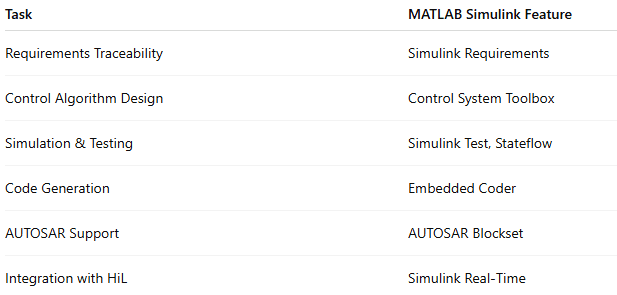
03. Model-Based Design (MBD): Industry’s Standard
Simulink popularized the concept of Model-Based Design.
Why does it matter in automotive?
- ? Visual Programming: Engineers can create block diagrams instead of writing low-level code.
- ? Faster Prototyping: Design iterations are quicker.
- ? Continuous Validation: Models can be tested at every stage (MIL, SIL, PIL, HIL).
- ? Automatic Code Generation: Eliminates manual coding, reduces bugs, and speeds up development.
Other tools like Scilab/Xcos, OpenModelica, or LabVIEW haven’t been able to match Simulink’s completeness and maturity in this domain.
04. Rich Ecosystem of Toolboxes and Blocksets
Simulink offers a modular, customizable ecosystem that covers every conceivable engineering need:
Popular Toolboxes:
- Simulink Control Design
- Stateflow (for FSMs)
- Simscape (physical modeling)
- Vehicle Dynamics Blockset
- Powertrain Blockset
- Simulink Real-Time
Each of these blocksets can be licensed separately and is continuously updated with support for new standards and technologies.
Competitors often fall short either in breadth (fewer features) or depth (less robust implementation).
05. Hardware and Tool Integration
Automotive engineers frequently use:
- CAN, LIN, FlexRay, and UDS protocols
- dSPACE, NI PXI, Vector VT System, ETAS
- AUTOSAR environments
Simulink supports plug-and-play integration with:
- CANoe (Vector)
- dSPACE HiL systems
- ETAS INCA
- XCP on Ethernet
- AUTOSAR Classic and Adaptive
This seamless compatibility creates a strong lock-in effect, as engineers can go from modeling to deployment without switching tools.
06. Regulatory and Safety Certification Support
In safety-critical automotive domains, compliance with standards like ISO 26262 is mandatory.
Simulink provides:
- Tool Qualification Kits
- DO-178C and ISO 26262 Certification Support
- Requirements Traceability Reports
- Model Coverage Analysis
This gives companies confidence in using Simulink for ASILD and other safety-critical modules. Alternatives rarely offer such extensive certification support.
07. Strong Industry Adoption and Community Support
- ? Over 5000+ research papers in automotive cite MATLAB/Simulink.
- ? Taught in most engineering colleges and universities.
- ? Used in major OEMs like Ford, Tesla, GM, Mercedes, BMW, Tata Motors, and Tier-1s like Bosch, Continental, ZF, and Valeo.
Because it’s widely adopted:
- Talent pool is readily available.
- Companies can hire with minimal onboarding.
- Community support (MATLAB Central, File Exchange) is immense.
This creates a positive feedback loop—new companies choose Simulink because everyone else is already using it.
08. Code Generation – The Game-Changer
MATLAB’s Embedded Coder can generate production-quality, MISRA-compliant C code for ECUs.
Benefits:
- ⏱️ Faster time to market.
- ? Fewer bugs from hand-coded logic.
- ? Reusability across projects.
Competitors like OpenModelica or LabVIEW may support code generation, but are often:
- ❌ Slower
- ❌ Less customizable
- ❌ Not MISRA-compliant
09. Why Alternatives Haven’t Succeeded

a) Open-Source Tools:
Scilab/Xcos, OpenModelica, GNU Octave
- ✅ Free
- ❌ Poor documentation
- ❌ Limited industry integration
- ❌ No certification support
b) Other Proprietary Tools:
- LabVIEW (NI): Focused more on test automation.
- Altair Activate, MapleSim: Too niche.
- ETAS ASCET: Great for code generation but not as flexible in modeling.
- ❌ Most are not MBD-friendly.
They either lack industry penetration, ecosystem, or support for full V-cycle development.
10. Pricing vs Value: Why Automotive Still Chooses Simulink
Yes, Simulink is expensive.
But in automotive, reliability, support, certification, and time-to-market matter more than tool cost.
An ECU bug in production costs millions. Simulink helps catch bugs early, reduce manual errors, and meet deadlines, making its high price justifiable.
11. Recent Innovations Strengthening MATLAB’s Position
- ? Support for AI/ML workflows
- ? Integration with ROS, Autonomous Driving Toolbox
- ? Mobile and web deployment using MATLAB Compiler SDK
- ? Cloud support via MATLAB Online, MATLAB Drive
MathWorks is continuously evolving its tools, ensuring that it stays ahead of potential competition.
12. Is There Any Hope for Competitors?
Only if a tool can match:
- ? The breadth of blocksets,
- ? Seamless hardware integration,
- ? Industry certification readiness,
- ?? Community and enterprise support.
Some areas where disruption could occur:
- Open-source AI frameworks for AVs
- Python + SimPy + Jupyter-based modeling (not mature yet)
- AUTOSAR Builder-based tools with native MBD
But as of today, no tool even comes close.
13. Conclusion
MATLAB Simulink is not just a tool—it’s a full ecosystem, deeply entrenched in the automotive development pipeline. Its maturity, adaptability, and industry support make it the de facto standard.
Unless a major shift occurs—such as an open-source revolution in MBD or a full-stack competitor emerges backed by a major automotive alliance—Simulink’s dominance will likely continue.
This was about “Why There Is No Competitor For MATLAB Simulink In The Automotive Industry“. Thank you for reading.
Also, read:
- “Mother of All Deals”: How The EU–India Free Trade Agreement Can Reshape India’s Economic Future
- 10 Free ADAS Projects With Source Code And Documentation – Learn & Build Today
- 100 (AI) Artificial Intelligence Applications In The Automotive Industry
- 1000+ Automotive Interview Questions With Answers
- 2024 Is About To End, Let’s Recall Electric Vehicles Launched In 2024
- 2026 Hackathons That Can Change Your Tech Career Forever
- 50 Advanced Level Interview Questions On CAPL Scripting
- 7 Ways EV Batteries Stay Safe From Thermal Runaway